Libretti

Sun-Dogs

Sun-Dogs is a setting of a poem by Michael Symmons Roberts. The text is richly allegorical, iconographic with a deep well of symbolism. The metaphors are complex, evoking a range of emotions and images, dark and terrifying one minute, radiant and ecstatic the next.

Reviews of Sun-Dogs

“The music itself was a revelation: a mesmeric blending of traditional and contemporary elements… a choral array of chanting and whispering, of shouting and speaking, of whistling and controlling disparate lines so that they wondrously merged… The co-creator of Sun-Dogs was British poet Michael Symmons Roberts who addresses theological and mythical symbolisms. Dogs, beggars, suns and stars turn into metaphors… The whole settled upon the ears like magic…”

Indiana Herald-Times

Libretti

The Birds of Rhiannon

This is a through-composed work comprising four sections and lasting about twenty five minutes. The final section is a coda involving a choir and the text is a poem with the same title by Michael Symmons Roberts.

The piece is essentially abstract, but was inspired by a myth from the Mabinogian (a collection of ancient Welsh stories). The Birds of Rhiannon are mystical, angelic presences which appear and sing on the death of Bran – a Fisher King-type figure who sacrifices his life (he is beheaded) for the sake of peace between two warring peoples. In essence the work could be described as being a dramatic concerto for orchestra with a mystical coda for choir.

Reviews of The Birds of Rhiannon

“…boldly coloured music, dramatic confrontations of ideas, a powerful surge of momentum, and instrumental lines that have an independent life but gel as a cohesive texture… MacMillan shares with Rimsky a virtuosity in defining and combining instrumental timbres.”

Daily Telegraph

“MacMillan swiftly segues into the Roberts poem, set with a particularly forthright mythic confidence. The poem itself is brazenly assured: “East means nothing now,/ nor West, no happenstance / of rock can bear the name of Britain”, and as a finale it is unarguably beautiful, a modern hymn that rises sumptuously aloft.”


Robert Stein, Tempo

Libretti

Quickening

Co-commissioned by the BBC Proms and the Philadelphia Orchestra and Chorus, with the Hilliard Ensemble and the Westminster Cathedral Choir, Quickening sets poetry by Michael Symmons Roberts exploring themes of birth, new life and new impulses.

The work’s three-fold vocal layers juxtapose mysticism and hyper-realism, painting a canvas at one turn intimate and private, at the next epic and celebratory.

Reviews of Quickening

Living Water, with which the work ends, climbs from the glimmering hum of temple bowls to the Mahlerian effulgence of an orchestral and choral climax.”


William Yeoman, Classical Source

“Spine-tingling, soul-stirring concert-hall experiences haven’t exactly been thick on the ground at this festival. So to hear massed Scottish forces hurling out James MacMillan’s sensational Quickening under Garry Walker’s cool-headed direction was thrilling…. Using a richly allusive libretto by Michael Symmons Roberts, it deals with the concept of birth in all its explosive, miraculous, life-changing and occasionally threatening forms.”

Richard Morrison, The Times

Libretti

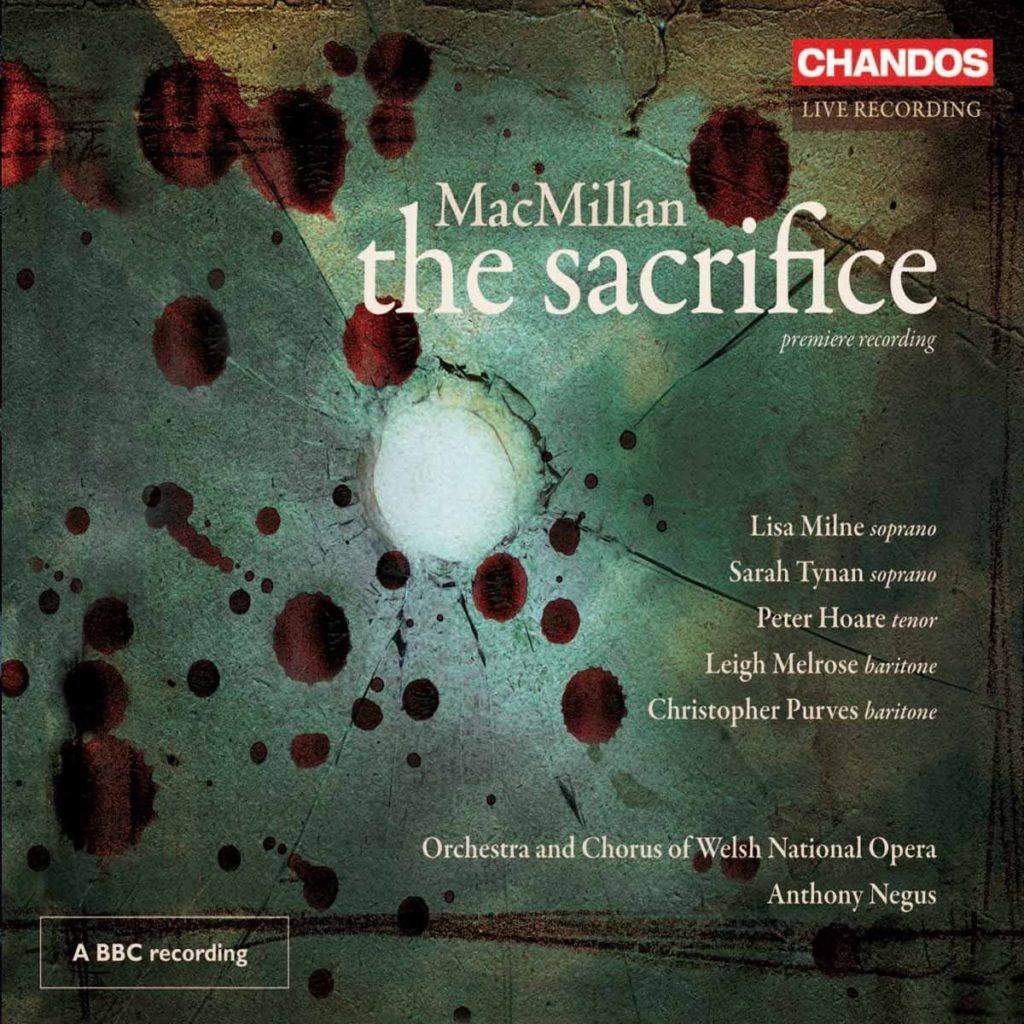
The Sacrifice

The Sacrifice is an opera in three acts composed by James MacMillan with a libretto by the poet Michael Symmons Roberts based on the Branwen story of the Welsh myth collection, the Mabinogion. The world premiere took place on 22 September 2007 at the Donald Gordon Theatre of the Wales Millennium Centre, Cardiff. The production was staged by Welsh National Opera, directed by Katie Mitchell and conducted by the composer.

Reviews of The Sacrifice

“…there are wonderful passages: a ravishing love duet underpinned by gorgeously folksy orchestration; Verdi-like declamations for the warlords; a choral threnody that summons the anguished modes of Eastern Europe to haunting effect; and a breathtakingly sonorous choral finale.”

The Times

“…the applause at the end was as warm as any I’ve heard for a new commission. For MacMillan has created a modern opera for people who dislike modern opera… Few operas enjoy premieres as well-executed as this.”

Independent on Sunday

Awards for The Sacrifice

WINNER OF THE RPS AWARD FOR OPERA

Poetry

Mancunia

Mancunia is both a real and an unreal city. In part, it is rooted in Manchester, but it is an imagined city too, a fallen utopia viewed from formal tracks, as from the train in the background of De Chirico’s paintings. In these poems we encounter a Victorian diorama, a bar where a merchant mariner has a story he must tell, a chimeric creature – Miss Molasses – emerging from the old docks. There are poems in honour of Mancunia’s bureaucrats: the Master of the Lighting of Small Objects, the Superintendent of Public Spectacles, the Co-ordinator of Misreadings. Metaphysical and lyrical, the poems in Michael Symmons Roberts’ seventh collection are concerned with why and how we ascribe value, where it resides and how it survives. Mancunia is – like More’s Utopia – both a no-place and an attempt at the good-place. It is occupied, liberated, abandoned and rebuilt. Capacious, disturbing and shape-shifting, these are poems for our changing times.

Reviews of Mancunia


from The Observer


MANCUNIA by Michael Symmons Roberts review – intricately varied


In a collection that constantly defies expectation, the British poet offers a strikingly imaginative portrait of the Manchester in which he lives.


Kate Kellaway


There are many ways of occupying a city and Michael Symmons Roberts, in his superb, substantial and intricately varied seventh volume, reminds us it is a complicated business: we live in cities imaginatively as well as actually. Sometimes, we are painfully adjacent, shallow-rooted, trying to take hold.


This book offers only a notional portrait of the Manchester in which Symmons Roberts lives. It has become Mancunia, the city as it exists in his mind. This is his first collection since the masterly Drysalter, which won the Forward prize and Costa poetry award, and was, you might have reasonably supposed, an impossible act to follow.


Yet with each reading of this volume, one sees more – as one’s eyes adjust to the dark. For in many of these poems light is wanting (in both senses of the phrase). Mancunian Miserere is a good example of a poem about going against the city’s grain and his own. He wishes to atone for a “constancy of inattention”, while the poem offers evidence of the contrary on a tormented walk down Cross Street (the city a version of his own body). I love the peculiar detail about the “undersides of leaves” prefiguring a storm, and the implication that if he knew to notice this, it would somehow help him. Symmons Roberts’s writing runs as unhindered as the rain he describes. Yet he registers the way in which he feels blocked: “prise my teeth apart O God that I might learn to praise”.


Praise is so easy it can become difficult. Affirmation is never straightforward. Love Song on a Loop explores the idea that the expression of love is a devalued currency: “And so this song undoes itself,/unwinding into gibberish./Nonetheless, it started/true enough, I feel it, so help me.”


The stumbling block is that emphasising the positive can seem inauthentic or impersonal. Master of Lighting Small Details (honouring a Mancunian bureaucrat) is a poem that could be taken as a riposte to Robert Frost’s The Road Not Taken – the road not taken resembling the love unspoken.


We begin in a dark bar, with a raised glass to “the way things are/and might have been, if I had just…” And then an image strikes:

Yet all those miles away some clutch

of thistles catches midday sun with such

rare glory that a traveller through

that field may stop to take it in as though

the glimpse of it was meant for him, and walk my path as it were his own.


It is a charmed moment, but hastily shelved – the light put out.


One of the wonderful things about Symmons Roberts is his way of pushing poems – and himself with them – in a direction you were not expecting. He constantly reconstitutes the world.


In the marvellous Tightrope Song, Symmons Roberts tells of a dazzling gymnast from the rope’s point of view. Similarly, a poem about a wall encourages us to consider the entire wall and not merely our half of it. In a brilliant, unnerving poem entitled The Future of Books, Symmons Roberts envisions literature reprocessed: “Our slice has its own distinctive shade and scent/ – paper-musk, the dark behind bookshelves – /but it so mystifies our future selves/they fry it like black pudding, a salt and bitter/jus of atlas, sonnet, gossip, scripture.”

Symmons Roberts scoops up that remaindered dark in handfuls.


And possibly the best poem in the collection is In Paradisum, about Manchester’s refugee children. Here, Symmons Roberts reminds us of how easy it is to see human extremity without seeing it – a moving feat in what is a first-rate collection.


Poetry / The Observer / reviews /


Review from THE OBSERVER

Awards for Mancunia

T S Eliot Prize – shortlist

Poetry Book Society Recommendation


Extract from Mancunia

GREAT NORTHERN DIVER


Mancunia at night looks like embers from above,
but hold the dive and it reassembles, cools,
coalesces into districts, flyovers, a motherboard,

now stadiums like unblinking eyes,
car lots set out as piano keys, parks with lake wounds,
counter-flow of arteries in red and white,

the bass clef curves of cul de sacs
in outlying estates, then factories with starting guns
of smoke that sting and make you squint,

now you can pick out individual cars, nags’ heads
down in dark fields, glow of dressed shop windows,
drunks on their tightrope walk home,

black poplars’ ragged tops, roof tiles, kerbstones,
air that drops from ice to cloud to everything a city
cooks at once until the road meets you

face‑to‑face, down and under, slower, denser
and the clay arrests you, holds you as a pulse for good,
so what keeps this city alive is you.


Libretti

Raising Sparks (libretto)

A song cycle with James MacMillan, premiered at London’s Royal Festival Hall. Since performed in France, Spain, Canada, Australia, America. Broadcast on BBC Radio 3. Released on CD in 2002.

Reviews of Raising Sparks (libretto)

“Martyn Brabbins and the Nash Ensemble here offer a superb recording of a major work by James MacMillan… This 35 minute cantata on the theme of creation and redemption, inspired by Roberts’s poem, and by the writing of the Jewish author Menahem Nahum, takes one inexorably through a kaleidoscopic sequence of symbolic images, with one vivid simile piled on another in Roberts’s striking language.”

 Edward Greenfield, Gramophone

“[Raising Sparks]… is as dark as Mussorgsky, as awesome as Akhmatova. MacMillan makes Roberts’ words flow as naturally as psalm-pointing. One moment he is as desolate as Rilke (“came a single lightning bolt”), the next as subtle as Sappho or a Tang dynasty poem (“Under my shell was a smithereen of sun/ hidden in snow among wild yellow olives”)…..the effect is hypnotising.”

Roderick Dunnett, The Independent

Fiction

Patrick’s Alphabet

When a teenage couple are found murdered in their car, a boy called Adam Sligo is the only suspect. The letter A is found blazoned on the wall at the murder scene and is soon followed, around town, by the other letters of the alphabet, each immaculately painted in red. What do the letters mean? Is Sligo playing games with the police? Or putting a spell on the town?

Perry Scholes is mixed up in all this from the start: a man haunted by cars and death – and photographic images of both. He trawls the motorways and edgelands listening to police radio, getting to the car-crash or the crime scene before them. He makes a living selling these shots to the papers. He is the one who spots the painted letters, and begins to document their appearances.

As the town is paralysed by fear and paranoia, a vigilante cult emerges, arming itself for the battle against evil. Perry finds himself trapped in a nightmare. A killer is at large, and the alphabetical messages he leaves seem to be personal messages for him.

Reviews of Patrick’s Alphabet

“An intriguing, gripping and highly unconventional crime novel”

Joseph Farrell, TLS

“What makes this book different is its use of language. The narrative voice turns from a dark whodunit into something more intriguing. But Roberts never forgets that his principal responsibility is to keep us hooked – and that he does with aplomb”

Barry Forshaw, Daily Express

“Reminded me at different times of Camus’s The Plague, Kafka’s The Castle… A disturbing and intense piece of fiction”

Peter Guttridge, The Observer

Extract from Patrick’s Alphabet

An extract

A was written in blood where the bodies were found. It was paint, but the story went round town that it was blood. More than that, the story said Michelle had dipped a finger in her gaping chest, to write a message on the concrete car park wall. She had finished the first letter, then collapsed.

The first letter of what? Her friends said it must have been the name of the killer. She was writing ADAM SLIGO, but her life ran out at A. Her sister Ally clung to the idea that it was ALLY I LOVE YOU, or ALLY DON’T WORRY. There was even a stupid theory that it wasn’t A at all, that she was desperate and unable to shout, that she struggled to the wall and tried to write HELP in her own blood. It was really H, but she was so weak that the uprights fell into an A.

A few people knew that it was paint, and knew it had nothing to do with Michelle. The police who were second on the scene were certain she had never left the car. The shots were fired at close range through the windscreen of Jake’s old blue BMW. Jake and Michelle both died in their seats. All the blood, and both victims, stayed inside the car.

I had evidence that Michelle didn’t write the A. I got there first as always. I had to get my work done before it was all cleared up. When I arrived, they were both dead, and in the background of my shots the wall is clean.

Proof counts for nothing unless it’s your own proof. I’ve thought a lot about this. I could have had one of my pictures blown up to billboard size and stuck it on the town hall. The red paint could have been sent for analysis, and the results bellowed through a megaphone by a man in a white coat. It wouldn’t change a thing for those who thought Michelle had left a final, cryptic message.

Far from fading, as the weeks passed, the story grew. A lot of people in this town needed some last word from her. So I kept quiet about what I knew.

And what I knew at the start of that summer was this: after the murder, someone took a can of red paint and daubed a letter A at the crime scene. From the look of it, they used a brush and took some time. It was not a message. End of story.

Fiction

Breath

“Breath” is set in a country recovering from a brutal and divisive civil war between north and south. The war may be over but people’s memories are long and hatreds are slow to fade. A teenage boy, Jamie, is knocked off his bike and dies in a city street. His father, Geoff Andrews, manager of the main hospital, is asked if he will allow one of Jamie’s lungs to be removed and flown north for a transplant. He agrees, and the mercy mission begins: six hours to get the lung out of one body and into another.As the night unfolds, and the plane travels through storms across the war-ravaged country and over the border, we see the drama from three different perspectives: Andrews, grieving for the son he perhaps never knew well enough – this one single death overwhelming, even after the deaths of so many; the lung’s recipient, Baras, an old man fighting for breath, and life – a northerner with blood on his hands; and in the turbulent sky between them, Jude, the young pilot, who is closest to Jamie – or at least to his breath, his spirit, his voice.

A novel about violence and vengeance, and what must take their place, “Breath” is a moving and timely examination of the fractures of war and grief and the long struggle towards peace and reconciliation.

Reviews of Breath

“Symmons Roberts is already a poet of note, and this, his second novel, is discernibly a poet’s book. Short and introspective, it stays in the mind and echoes.”

Times

“Inventive in its form and often profound in its poetry, this gripping story is also a meditation on the difficulty of forgiveness in wartime.”

Telegraph

Non-fiction

Edgelands

The wilderness is much closer than you think. Passed through, negotiated, unnamed, unacknowledged: the edgelands – those familiar yet ignored spaces which are neither city nor countryside – have become the great wild places on our doorsteps.

In the same way the Romantic writers taught us to look at hills, lakes and rivers, poets Paul Farley and Michael Symmons Roberts write about mobile masts and gravel pits, business parks and landfill sites, taking the reader on a journey to marvel at these richly mysterious, forgotten regions in our midst.

Edgelands forms a critique of what we value as ‘wild’, and allows our allotments, railways, motorways, wasteland and water a presence in the world, and a strange beauty all of their own.

Reviews of Edgelands

“Edgelands delights with its sly, impish wit and observation”

Spectator

“eye-opening and hugely enjoyable book … overall this is an original, surprising and rather wonderful addition to our literature of place”

Sunday Telegraph

“in this marvelously quirky, fascinatingly detailed and beautifully written book the two authors fulfill their brief triumphantly”

Daily Telegraph

“a book that begs us to use our imaginations; to appreciate what we pass by every day but never really see”

Metro

“A haunting, often inspiring book… Edgelands covers an impressive range of politics, reminiscence, investigation and rumination.”

Scotland on Sunday

“a masterpiece of its kind… this is, quite simply, beautiful, but it is also typical of a beautifully conceived work of exploration, by two emissaries to the wilderness who do the wasteland proud.”

The Times

Poetry

Her Maker’s Maker

Pamphlet of three nativity poems, published Christmas 2002 by Phoenix Poetry Pamphlets, Nimes, France.